Sunday, October 23, 2016

Tech Contract and Tech Letter

Tech Contract
Technology Contract For a Fake School

Teachers, Students, Administrators and Parents are expected to understand and/or follow the parameters laid out in the following document and are subject to punishments and repercussions if these parameters are not followed and/or understood. Please read through and sign the following document and return this to Mr. Boyd by no later than tomorrow.

[  ] Students understand Tech is a privilege
[  ] Guided use is a must
[  ] Understanding not to tamper with soft/hard ware of School Devices.
[  ] No food or drink near tech
[  ] Stay on your own account do not tamper with others.
[  ] Only visiting teacher approved sites
[  ] Headphones and personal devices are only to be used by teacher’s discretion.
[  ] Not sharing personal identification information
[  ] Understand damage forgiveness
[  ] Understand what level of ownership of a device you have     
[  ] I forfeit the rights to have a computer issued by the school.
[  ] Respecting privacy (i.e. not sharing photos of others without permission)

I understand and agree to all of the following, and submit to the consequences if any or all of these are broken.
Student's name.                                     Student's signature.                              Date
_________________________.       ___________________________.    _________
Parent/guardian name.                          Parent/guardian signature.                    Date
_________________________.       ___________________________.    _________


Technology Letter

Fake Union High School
Technology Agreement letter
2016/2017 School Year

Dear Parent or Guardian of a Fake Union High School student, During this transitional period in our school year, our administration has deemed necessary for our students to be allocated the means to interconnectivity through “One to One” technology. Our one to one program is intended to allow students to be immersed in the world of technology through educational formats, in order to propagate interests and proficiency in academic areas whilst allowing educators to further personalize learning in order to better reach and react to their interests.

Leading up to this administrative decision, students have been slowly weaned into the concept and application of technology in the classroom. Many classes already incorporate technology in their classes in the forms of smartphone apps and classroom laptops which students can rent out of our high school library. We believe that this early immersion will act as a broad base for students to expand upon in order for them to greater understand the use and responsibility in accordance with our expectations of this one to one initiative.  
The one to one initiative in our school has a lot to offer your children and we foresee tremendous growth with them through the tools a laptop has to offer. There are many free to download programs that we can use to thoroughly engage our students in nearly every class; other programs that cost money the school is willing to/has purchased for use on the laptops they will be receiving. The laptops offer more opportunity to individualize projects, and also gives them their own time to do their work when at home. When every student has their own computer, they can share information quicker and easier, as well as collaborate more efficiently.

Students are expected to care and maintain for their laptops for the course of the school year. Students are expected to bring their laptop charged to class. If any issues arise with the technology it is imperative that students bring their laptop to the IT department to resolve the issue. Outside of system and program updates students are expected to have school faculty perform maintenance on their tech. Since students are allowed to bring their tech home they can use the computer for personal use as well. Students are allowed to download programs and store data on their laptops. Be aware though at the end of the year the laptops are factory reset so make sure any personal data that you want to keep is saved externally!
        
It is very clear that this will be new to many of you, and you may be uncomfortable with your child having a large responsibility and tool at their disposal. You may be worried, for instance, that your child may not be able to properly take care of such a large responsibility and that they may break it. The school has implemented an insurance policy, wherein an initial fee of 25$ and a deductible of 25$ will cover any accidental damage done to the laptop just in case. You may also be worried that they will be distracted by their computer in school, but we have installed an app that monitors their laptops during and only during school hours, to make sure they are not doing inappropriate tasks. At home, the distractions may be useful to teach your child how to manage time between fun and work. During school, your students will also be taught how to use their laptop and surf the web safely, as well as shape an appropriate online identity.

Attached to this letter is the Fake Union High School Technology Contract which will require you and your child’s careful review and signature. We ask that the content of the contract and the contents of this letter is diligently assessed and that any questions that you or your child may have about the contents are posed to our administration at
FakeUnionHS@gmail.com.
Thank you for your time.
Sincerely, Administrative Staff of Fake Union High School.

Tech Contract and Technology Letter
The Both the technology contract and the technology letter were  group endeavors by myself and other students in the secondary education program. The technology contract is a list of explicit expectations of the students with regards to technological integration in the classroom. Outlining what is permitted and proper conduct in the classroom. An agreement between teacher, student and parent as to how the technology will be implicated in the classroom. The technology letter states the reasoning and offers a more in depth description of the pseudo tech program. Its purpose being to inform students and parents in depth the use and application of tech in our school’s classroom.

Performance Criterion 4.2: Candidates accurately address common misconceptions of the discipline.
I believe through the process of creating both a technology contract and a pseudo letter to parents regarding how technology would be used in the classroom, allowed us as future educators to consider the misconceptions that are often associated with tech implication in a classroom. I feel as though oftentimes tech integration is seen as a cure all for improving a school's educational practices. I believe that going through this exercise really allowed us to consider multiple dimensions that result from the implication of a 1 to 1 technology initiative. That, while technology has the potential to enhance the learning experience of students; its effectiveness relies on the best judgement of the educator. The potential of tech in the classroom is not only limited by its availability but also how effectively it is implicated by the instructor.

Reflection
As a future educator I hope that the use of technology in the classroom can provide the opportunities for a more in depth and complete learning experience for students in the modern age. That with technology comes not only more accessible and more diverse assessment and learning tools but also more pathways for students to accumulate knowledge and engage as citizens in a global community. I believe that technology has the power to empower students by providing more opportunities for students to convey learning and original ideas. I also believe that technology has the potential to create more globally literate individuals, that it has the power to inform provide future generations with the wherewithal to create positive change in the world. I genuinely believe we are at the tip of the iceberg with regards to the way technology will change and reshape the way we interact with each other and the rest of the world. With that being said, the ever increasing complexity of technology and its implications in our world also spearheads my biggest concerns with tech and tech in the classroom. I worry that as a future educator the tech skills I teach the students in my classroom will prove useless or outdated after a short period as tech evolves into new forms and formats.
I think my biggest takeaway from this lesson was the value of clear expectations with regards to tech and the use of technology in the classroom. That explicit and clear understanding between the instructor and their pupils on how they will use tech in the classroom is crucial. Having a set list of boundaries and expectations to refer to create a solid foundation for how technology will be used in the classroom. This lesson also allowed me to further consider the different dimensions of tech integration as well. That the student, teacher and parent/legal guardian each have their own realm of concerns and perspectives on technology in the classroom. Technology is its own wide encompassing dimension that has many implications both in and inside the classroom and like any tool has its own strengths and limitations. When used properly it can enhance the quality of learning but, without proper implication tech can be as effective as hammering a nail with a screwdriver.

Thursday, October 13, 2016

El Deafo Panel


El Deafo Panel
The El Deafo panel involved 5 panelists of different experiences with/of deafness and in the deaf community. The panelists responded to questions from a moderator and then opened up to the audience for additional questions. Honestly, prior to this event I had never seen American Sign Language used in person and I was blown away with both how expressive and efficient it was as a language. Generally thinking I don’t think I have done much thought as to what challenges and obstacles deafness in any form could create, or how deafness is a different experience between those with severe hearing loss.


Connection to PC
Performance Criterion 2.2: Candidates use an understanding of diverse cultures and communities to design inclusive learning experiences.
After attending this event I can say without a doubt I have a better understanding of the experience and difficulties that revolve around deafness and hearing loss. Having a better knowledge of the deaf experience will help me to cater to provide better accommodations and approaches to teaching learners with hearing loss. Knowing how hearing loss affects a learner and changes their experience in a classroom makes allows me to be more informed on one of the many diverse learning needs of students. Knowing more about the deaf community also will help me to be more informed on the cultural implications of deafness as well. Allowing for me to be able to have a better understanding of students that may be part of deaf culture, as well as being able to better inform my own students about deaf culture.


Reflection
I think first both from the graphic novel “El Deafo” and the panel I attended I learned a fair amount more about the deaf experience than I had before. As I stated previously this new knowledge will help me to better understand how to inform students about the deaf experience and how better form my approaches to teaching students with hearing loss. Attending this event also made me realize that deafness constitutes for only one of the many diversifying factors of students and that only one factor can be enough to create a diverse spectrum of needs. Each student's brings their own skills and weaknesses to the classroom and to provide the best education possible one must know how to approach the unique needs of each student.

One line that stuck with me from the night was “Don’t make a big deal about it”. Often times I feel when in education when a student with a disability is taken into account they are taken from a disability first standpoint. Meaning that educators and educational institutions focus on addressing the needs of the disability in the classroom but forget about the needs of the student. If the student’s disability becomes the central part of the approach the student may feel singled out from his or her peers. This may lead to the student feeling uncomfortable in the classroom making it even harder to address the student’s needs as they may feel demotivated or stressed. My biggest takeaway from that is what comes first is creating a comfortable learning environment that doesn’t single out students or create exclusivity. That students regardless of their capabilities each have their own realm of concerns and require a safe learning environment.

Sunday, September 25, 2016


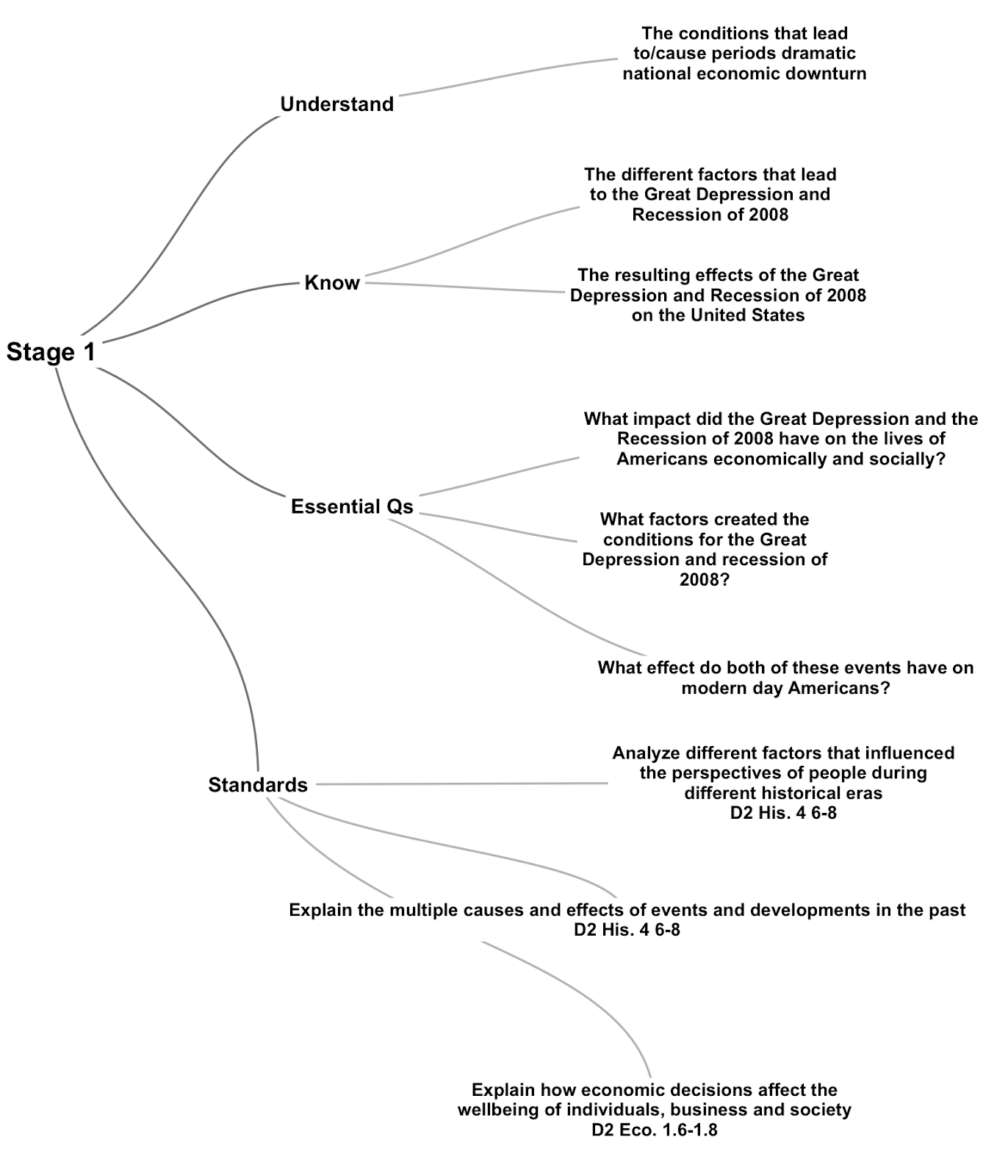
Stage I – Desired Results
Established Goal(s) [all standards/proficiencies]:
  • D2 His. 4 6-8 Analyze multiple factors that influenced the perspectives of people during different historical eras
  • D2 His.4 6-8 Explain the multiple causes and effects of events and developments in the past
    • D2 Eco 1.6-8 Explain how economic decisions affect the wellbeing of individuals, business & society
Understanding (s): Students will understand that…
  • The different factors and results of the the Great Depression and the Great Recession
  • Form a working understanding of the factors and causes of the Great Depression and Great Recession
Essential Question(s):
  • What impact did the great depression and recession of 2008 have the lives of Americans economically and socially?
    • How were the experiences across each period similar? How were they different?
  • What factors created the conditions for the great depression and recession of 2008?
    • How were the experiences across each period similar? How were they different?
  • What effect do both of these events have on modern day Americans.  
Students will know…
  • The different factors and results of the the Great Depression and the Great Recession
Students will be able to…
  • Use research skills to pull ideas and content out of historical and narrative texts.
  • Draw connections from the past to understand the lasting influence of these events on American life
The performance assessment I was considering for my unit of study was a group presentation followed by a group discussion to culminate the unit. The first part of the final assessment I would have the class split into two separate groups; one for the Great Depression and another for the 2008 Recession. Each group would independently research for a set portion of the unit and at the end of the research period the groups would create a presentation and teach the other half of the class about their event. Through presenting I would be able to see how effectively students apply their research skills when drawing information through content. The second part of the assessment would involve a class discussion comparing and contrasting the two events around the basis of our essential questions. The group discussion would allow for me to assess understanding at an individual level of the content. Between both of these assessment strategies I feel as though I could reach a fairly competent judgement on whether or not students reach the proficiencies selected for my unit.


Performance Criterion 7.2: Candidates plan instruction by drawing upon knowledge of learners to meet rigorous learning goals.


Through assessing with a presentation and a group discussion I put a significant level of student achievement in the hands of the students. How effectively students use their research skills and allocate time will reflect their level of achievement. How much effort students put towards their own achievement in this unit will reflect on the class’s achievement as well. Since students become responsible for educating their peers the knowledge they acquire and distribute will be what influences the level of understanding and content acquisition of the class. Thus how effectively students learn and distribute their knowledge will determine if the students can achieve proficiency with the standards outlined in the unit.
At this point in time I would argue my lesson plan is in a state of near infancy. Conceptually I believe that I have an understanding of how to reach this performance criteria within my unit. I would argue that I would know how to go about how to using student knowledge to set and meet learning goals. My next steps would be to put the methods of reaching this performance criteria in more concrete terms and then putting them into practice within a classroom. Through specifying assessment I can more clearly display what specific methods I would use in the classroom to demonstrate that student knowledge is directing the learning goals of the unit. Then through putting those methods into practice I can obtain an higher level of proficiency through the act of real world application.  

Sunday, September 11, 2016

Education Philosophy and Defining Literacy


-Using the App Explain Everything we were assigned to create a multimedia presentation explaining our education philosophy. The presentation was to be 3-5 minutes long and required insight on at least two theorists/philosophers.
-Using the App Shadow Puppet in pairs, we defined what digital literacy is and what various forms of literacy there is within our own content areas.
Our graduates are reflective and contemplative practitioners.
The processes through which these projects were created by defining literacy and my educational philosophy were most definitely reflective and contemplative experiences on my pathway to becoming a future educator. Through defining my educational philosophy I was able to think about how my education philosophy will effect my approaches and motivations when teaching. The process made me reevaluate my motivations for teaching and what I’d like to accomplish as a future educator.
Performance Criterion 4.1: Candidates accurately communicate central concepts of the discipline.
Through defining literacy within history with the Shadow Puppet presentation I was able to identify some of the skills required of students within my content area. Thus forming a further understanding of what approaches to take in the classroom to guide students to become proficient and literate historians. Through the explain everything presentation on my education philosophy I was able to identify and explore some of the concepts related to being an educator in general. Allowing me to explore questions such as what are my goals and intentions as an educator, what approaches will I take when presenting an idea or concept or what approaches can be taken to help students discover and learn on their own tuition.
If the goal of education is to give individuals the skill sets to succeed within their respective society, than curriculum is the approach to providing those skill sets to students and literacy is the level of comprehension in each respective skill set. Through defining my education philosophy and defining what literacy means within my content area, I was able to further my understanding of the connection between literacy and curriculum. Within Social Studies research skills and the ability to contextualize content is part of being a literate individual in the field. Thus curriculum is the approach through which educators take to provide to provide those skill sets. Defining the specific literacy within my content area helped me to further refine ways to approach teaching. By forming a working understanding of what it means to be proficient in a skill set one can begin to form objective goals for their students to reach that proficiency. For example, through creating my presentation on the different forms of literacy within history I was able to further conceptualize curriculum forming questions within the field. Through doing so I was also coming to the realization that curriculum is built around objective literacy goals and the approaches through which to obtain those goals.  


When researching Critical Theory/Reconstructionism one specific quote kept coming into mind by Albert Einstein “No problem can be solved by the same level of consciousness that created it.” I found that quote to be congruent with the themes of Critical Theory. Through researching my education philosophy I reaffirmed my personal held belief that teaching is a necessary good for a society to be prepared to carry on in an ever more complex world.

Sunday, May 8, 2016

Reflection on Adolescent Dev. Case Study


Performance Criterion 1.1: Designs Developmentally Appropriate Learning Experiences
Through my case study I saw examples of developmentally appropriate learning experiences in use within his high school. Although my examples are limited by the experience MK has described to me and the material his teachers provided, I can definitely say in the case of my student I saw examples of good content and material use to improve the learning experience of my student. One specific instance is his teacher’s use of Newsela as a tool to help english language learners. Newsela is a program that provides periodical articles with a choose your own reading level feature. Users of the program can read the same article with different language complexities with numerical measurements for the complexity of the language. For ELL students and students that may struggle with reading this is a great resource that allows students to develop at their reading at their own pace as they have the power to choose reading appropriate to them.
Another example of developmentally appropriate learning in action in MK’s high school is through the dedicated education plan that exists for ELL students. The fact that the school possesses the know how and resources to educate non-english students is remarkable. Having specialized instructors and a specialized program to address a student need is a direct approach to developmentally appropriate learning. By catering to the specific need of a group of students and addressing the reality of that need the school is taking the direct approach to create an appropriate learning experience for these students.


Performance Criterion 2.1: Designs Inclusive Learning Experiences
The program MK’s high school has created or ELL students is an example of dedicated inclusive learning at work. The dedication of teachers and a learning space to address the need for a portion of the school’s students. By doing as such the school district accommodates for the needs of students that are often excluded in a typical classroom setting due to their language barrier. Having such a program allows for students to more smoothly transition into an english learning environment. Thus creating an approach to inclusive learning through addressing the developmental needs of your students.

Adolescent Dev. Case Study Link

Tuesday, April 26, 2016

Getting Better Through Authentic Feedback


Here is a video I found about a teacher taking a unique approach to feedback, through student lead focus groups. Every so often the teacher meets with chosen students to receive feedback on his own teaching. By doing so the teacher creates a unique opportunity to gain a student perspective on the teacher’s performance. I really appreciate this approach to feedback because it really creates an opportunity for discussions that often do not happen between a teacher and student. I see this method as an intriguing way to enter the mind of one’s own students and definitely intend to use such a practice in my classrooms in the future.

Wednesday, April 20, 2016

Guitar Lesson with MK

Last Wednesday MK and I added guitar lessons into our tutoring sessions as an extra treat. This came into being because recently MK and I entered a discussion about music during one of our tutor sessions. Through that discussion I learned that he recently had acquired a guitar and was attempting to learn. On top of that we both had our Wednesday afternoons free up with the change of seasons, allowing us to add an additional day each week to our tutor sessions. So for now until the remainder of the semester each Wednesday we plan to dedicate our extra time into learning guitar. I must say, I am incredibly grateful that South Burlington has given us this opportunity and has set us up with our own room to practice in.

Just from one session with MK I can see he has had a lifetime of experience with music and his raw musical talent is truly impressive. After one session he was able to improvise a guitar part to accompany a Nepali song that he knows. His rhythm is spot on and his ability to adapt technique from prior instruments into playing guitar after only a few short minutes was amazing. He hopes to incorporate playing guitar and singing into one of his religious ceremonies by the end of the spring, at first I was nervous as to whether or not we could reach that level after a few short sessions, but after Wednesday I have no doubt he can accomplish that goal.

Having this opportunity is incredible, I think often in schools moments of pure learning are often hidden under layers of assignments, tests and grades, but opportunities such as this break out as a pure learning experience. What I mean by this is that when learning an instrument there is no standard to meet, the end goal is improvement over one's prior self. Dedicated practice makes it so one is bound to improve every time they pick up the instrument. This makes learning quantifiable and quantifiable improvement is a huge self confidence boost for anyone. Feedback from a guitar is not hidden under layers of grades or assessments, it is raw and instant from the pick of each note.
I can only imagine that receiving this feedback and witnessing one's own development in such a manner is beneficial to one's self worth, especially for our ESL students. Music transcends language, for students who already may be doubtful of their self worth providing a point of pride such as music, could make all the difference.